

Students: How to Demonstrate Leadership in Nontraditional Ways
 The high school years are strategic times for teens to explore budding interests or full-fledged passions. However, over the past couple of years, COVID-19-related uncertainties have loomed large in students’ plans for in-person experiences. Some programs were canceled; others went online; still others suffered from staffing shortages, making the experience not quite as robust as it would have been pre-COVID. Though 2021-22 saw a great deal of “opening up” compared to the previous two school years, some students’ high school resumes still have some gaps.
As college application time approaches, the question becomes, “How can I show strong leadership experience when summer programs were canceled, and so many key organizations were (or still are) closed or extremely limited?”
College Acceptances – The Ever-Growing List
 Over the past 15 years, I’ve had the privilege of coming alongside numerous students and homeschooling families as a college prep coach. Whether it involved planning a high school course of study, teaching biology, writing, or literature through a homeschool academy, brainstorming ideas for personal statements, helping with the nuts and bolts of the college application, or working with parents on their “pieces” of the puzzle—the transcript, course descriptions, school profile, or counselor letter—it’s been a joy to be immersed in this exciting season of life.
For fun (and for inspiration during those intense weeks late in “college app season”) I enjoy keeping an ever-morphing list of colleges to which “my” students have been accepted.
Here’s the list! I’m so proud of all “my” students!
Sharpen Those #2 Pencils: Preparing for the SAT and ACT Exams

Homeschooled or traditionally schooled, most high school students have one thing in common: their dislike of the college entrance exams. To strong test-takers, these may simply be an inevitable annoyance; to others, they seem to have the power to permanently define one’s higher education path and perhaps even a future career. While the reality is rarely so extreme, homeschooled students need to be aware of how to approach these tests, since college admissions staff often place more emphasis on tests and less on homeschool-generated transcripts.
However, even before COVID-19, the testing “climate” was beginning to change–with some colleges going to “test-optional” protocols and some pondering “test-blind” arrangements (not even looking at test scores). Out of sheer necessity, the pandemic accelerated these trends, and many of these policies may be here to stay, post-COVID. But for homeschoolers, it’s wise to have a perspective on college admissions testing that results in providing colleges with more information, not less.
The Common Application®
The Common Application, which has been simplifying college applications since 1975, is the major player in the world of college applications. Homeschooling families, take note, as both student and parent have starring roles in this senior-year extravaganza.
College Prep Basics: The Top Ten
As a homeschooling family, chances are, the biggest question you hear (right after “What about socialization?”) is “How will you prepare your student for college?” Now that our two students are college graduates, I can use the clarity of hindsight to look back on our own journey and highlight the top ten principles that worked for us. Though every family is unique, these basics form a useful foundation for most homeschoolers traversing the college prep path.
Teaching Your High Schooler to Write

Classic writer’s block is that crippling paralysis that strikes when we’re expected to come up with eloquent, edifying words—typically, under the constraints of a time limit. But a different kind of writer’s block can strike homeschoolers seeking to meet the demands of high school level writing. Clearly, writing skills are vital for college preparation as well as for life, but for some, just trying to get started can bring on that vexatious paralysis. However, with a little forethought and the courage to just “plunge in,” you can successfully teach writing to your teen.
Course Planning Basics

Traditionally schooled students get to walk into a classroom and take a course for which someone has already done the hard work of planning—but which has the drawback of being “one size fits all.” For homeschoolers, designing courses takes some work and ingenuity. However, with the proper knowledge and perspective, students and parents can work together to come up with a course of study that will be equivalent to (or better than) an honors level course at a traditional school—and that fits the student’s needs and abilities.
Three main steps will start you on your journey: Research Your Requirements, Optimize Your Options, and Customize Your Courses.
Do Homeschoolers Get Senioritis?
Senioritis. Though it may not be listed in your physician’s medical dictionary, it is a real malady that traditional students, parents, schoolteachers, and counselors recognize and even come to expect. In a classic case of senioritis, a student begins to lose focus, motivation, and “drive” for completing work with excellence as graduation approaches. In mild cases, students may simply feel a reduced motivation to finish their work—especially once college acceptances are in and the remainder of high school seems to consist of “going through the motions.” In extreme cases, however, students may actually receive D’s and F’s in their courses.
Homeschooled & Headed for College
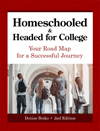
"Can homeschoolers successfully navigate the path to college?"
This question can be answered with a resounding "Yes!" It does take some advance planning and knowledge of the process, though. If you love homeschooling but need clear, step-by-step directions for the journey from high school to college, Homeschooled & Headed for College: Your Road Map for a Successful Journey is the book for you. It walks you step by step through the entire college prep process, from the beginning of middle school to the day you say goodbye to your new college student.
 Denise has developed a comprehensive guide to help homeschooling families design and implement a rigorous college prep program. Homeschooled & Headed for College discusses academics, electives, testing, and documentation, and she walks families through all aspects of the college selection and application process. Denise’s research and recommendations will save families precious time.
About the Author

Denise Boiko and her husband, Ron, homeschooled both of their children from kindergarten through high school. With acceptances to multiple colleges, both public and private, their daughter chose to attend Stanford University, and their son selected the University of Southern California. Since that time, Denise has successfully walked more than 150 students through the college admissions process and enjoys teaching group classes to local homeschoolers in the subjects of biology, anatomy and physiology, composition, and literature.
Ready to start the journey?
Order Homeschooled & Headed for College for the discounted price of $26.99.
Order now